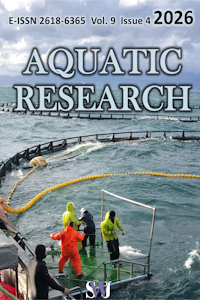
Economic performance and financial feasibility of pearl lobster (P. ornatus) grow-out aquaculture in South Sulawesi, Indonesia
Abstract
Aquaculture has quickly grown, with increasing interest in high-value products that contribute to the economic and social development of coastal communities. One example is the pearl lobster (Panulirus ornatus), which is in high demand and commands a high price. While production and research have improved, there is still little information on whether commercial grow-out systems are financially viable in Indonesia. This study examines the economic performance and investment potential of pearl lobster farming in South Sulawesi, Indonesia. Researchers gathered primary data from 94 farmers in three main production areas using a stratified sampling method. They measured economic performance by looking at profitability and analyzed investment feasibility using Net Present Value (NPV), Internal Rate of Return (IRR), Net Benefit-Cost Ratio (Net B/C), Payback Period (PP), and sensitivity analysis. The results show that pearl lobster farming yields a net profit of USD 1,584 per production cycle, indicating strong operations. Financial indicators also show that investing in this sector is attractive, with an NPV of USD 5,623, an IRR of 367%, a Net B/C of 13.25, and a PP of 0.35 years. Sensitivity analysis shows that the business remains financially sound in all tested scenarios. Even though investment results are most affected by changes in annual revenue, the project still produces positive returns when revenue drops, costs rise, or survival rates fall. This shows that the business is financially resilient. Besides confirming that pearl lobster farming is profitable, this study fills a gap by combining profitability assessment, discounted cash flow analysis, and investment risk evaluation into a single framework. The findings offer real-world evidence to help guide investment decisions and policy for tropical lobster aquaculture. In summary, the results suggest that pearl lobster grow-out farming is a strong, resilient business and deserves serious consideration for future development.
Keywords
- Pearl lobster aquaculture
- Financial feasibility
- Investment appraisal
- Sensitivity analysis
- Sustainable aquaculture
Ethical Statement
References
- Aïzonou, R., Achoh, M. E., Hountcheme, I. A. C., Agadjihouèdé, H., Ahouanssou-Montcho, S., & Montchowui, E. (2021). Zootechnical knowledge of floating cage aquaculture in freshwaters ecosystems and load capacity determination. The Egyptian Journal of Aquatic Research, 47(1), 81–86. https://doi.org/10.1016/j.ejar.2020.10.013
- Ariadi, H. F. M. M. M., Fadjar, M., & Mahmudi, M. (2019). Financial feasibility analysis of shrimp vannamei (Litopenaeus vannamei) culture in intensive aquaculture system with low salinity. ECSOFiM (Economic and Social of Fisheries and Marine Journal), 7(01), 95–108. https://doi.org/10.21776/ub.ecsofim.2019.007.01.08
- Asche, F., Cojocaru, A.L., & Roth, B. (2016). The development of large scale aquaculture production: A comparison of the supply chains for chicken and salmon. Aquaculture. https://doi.org/10.1016/J.AQUACULTURE.2016.10.031
- Astuti, N.W., Sudewi, G.N.A., Fahrudin, Asih, Y., & Slamet, B. (2023). Fish and shrimp hydrolysate as additives in lobster feed formulation: effect on growth, survival, feed consumption of spiny lobster (Panulirus homarus). IOP Conference Series: Earth and Environmental Science, 1137. https://doi.org/10.1088/1755-1315%2F1137%2F1%2F012027
- de França, V. F. C., da Silva, L.O.B., da Silva Oliveira, E.J., & de Andrade, H. A. (2024). Economics of small-scale aquaculture farms in the Brazilian Northeastern semi-arid region: characteristics, feasibility, and profitability models. Aquaculture and Fisheries (2096-1758), 10(5). https://doi.org/10.1016/j.aaf.2024.07.003
- Diatin, I., Shafruddin, D., Hude, N., Sholihah, M.A., & Mutsmir, I. (2021). Production performance and financial feasibility analysis of farming catfish (Clarias gariepinus) utilizing water exchange system, aquaponic, and biofloc technology. Journal of the Saudi Society of Agricultural Sciences, 20(5), 344–351. https://doi.org/10.1016/j.jssas.2021.04.001
- Divu, D., Mojjada, S.K., Sudhakaran, P.O., Sundaram, S.L., Menon, M., Mojjada, R.K., Tade, M.S., Vishwambharan, V.S., Shree, J.S., Subramanian, A., Ignatius, B., & Gopalakrishnan, A. (2024). Economic performance and marine policy implications of mud spiny lobster mariculture in Tropical Sea Cages, North-Eastern Arabian Sea, India: An empirical study in marine economics. Marine Policy. https://doi.org/10.1016/j.marpol.2024.106041
- Food and Agriculture Organization (FAO). (2022). The state of world fisheries and aquaculture 2022: Towards blue transformation. Rome: FAO, pp. 1–11. https://doi.org/10`.4060/cc0461en
Details
Primary Language
English
Subjects
Aquaculture and Fisheries (Other)
Journal Section
Research Article
Authors
Muhammad Hairul Haj
*
0009-0006-6429-2999
Indonesia
Aris Baso
0000-0002-5005-0861
Indonesia
Sri Suro Adhawati
0000-0002-9457-3963
Indonesia
Early Pub Date
September 11, 2026
Publication Date
October 1, 2026
Submission Date
July 14, 2026
Acceptance Date
August 23, 2026
Published in Issue
Year 2026 Volume: 9 Number: 4